UWB Spatial Pointing Interactive Remote Control Solution: Ushering in a New Era of “Point-and-Control” Large-Screen Interaction
With the rapid development of smart TVs, intelligent displays, home entertainment, and spatial smart terminals, traditional remote controls are evolving from button-based operation to spatial interaction. Users are no longer satisfied with navigating through complex layers of menus. Instead, they expect a more intuitive, precise, and low-latency control experience. Against this backdrop, the UWB spatial pointing interactive remote control solution has emerged, bringing a brand-new control experience to TVs, set-top boxes, conference displays, smart home control panels, and other scenarios.
By integrating UWB chip-based positioning information with IMU attitude sensing capabilities, the UWB remote control delivers a precise “point-and-control” interaction experience. Users only need to point the remote at a target area on the screen or in space to perform actions such as selection, swiping, confirmation, and dragging, making large-screen interaction feel as natural as using a mouse. For brands upgrading their smart interaction experience, the UWB omnidirectional pointing remote control is not only a hardware innovation, but also an important entry point for product differentiation and improved user experience.
At the technical level, this solution offers centimeter-level precise positioning. Based on UWB technology, positioning accuracy can reach ±3 cm, enabling a “what you see is what you control” spatial pointing experience. At the same time, UWB uses nanosecond-level non-sinusoidal narrow pulse transmission, with a signal bandwidth exceeding 500 MHz. This gives it natural anti-interference advantages, allowing stable connectivity and fast response even in complex home environments, meeting rooms, and multi-device coexistence scenarios.
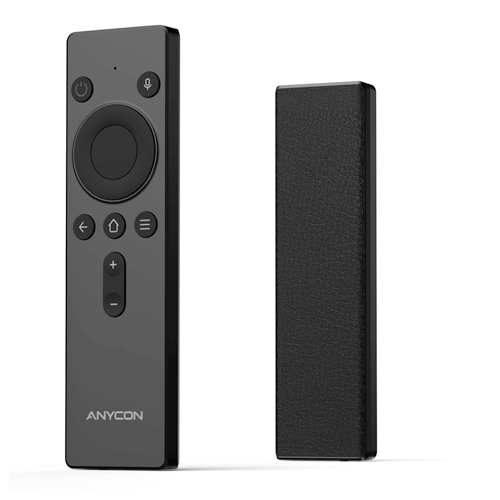
The solution also integrates ToF and AoA algorithms. Through Time of Flight and Angle of Arrival measurements, it enables precise positioning and directional recognition in three-dimensional space. This means the remote control does more than simply connect to a device. It can understand where the user is pointing, how the user is moving, and what the user intends to control. Combined with IMU attitude sensing, the smart UWB TV remote control can further enhance spatial gesture recognition, cursor control, motion-based interaction, and other experiences, meeting the upgrade needs of next-generation smart TVs and intelligent display products.
In terms of application scenarios, the UWB spatial pointing interactive remote control can be widely used in smart TVs, OTT boxes, projection devices, smart hotels, conference panels, educational displays, smart home control panels, in-vehicle entertainment systems, and more. In the living room, it allows users to complete content searches, app switching, and gaming interactions more easily. In meeting scenarios, it helps presenters quickly control large-screen content. In hotels and commercial display scenarios, it reduces the learning curve and delivers a smoother interaction experience.
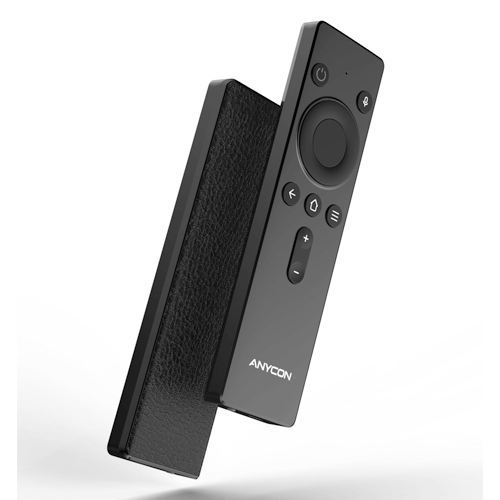
With the development of AI TVs, spatial computing, smart homes, and multi-screen interconnection, the role of the remote control is changing. The remote control of the future will no longer be just a TV accessory. It may become an entry point for home spatial interaction, a control center for smart devices, and a hub for human-machine interaction. UWB-enabled TV remote controls will become an important direction for brands looking to upgrade high-end product lines and create differentiated selling points.
It is foreseeable that UWB technology will continue to unlock value in the field of smart terminal interaction. With advantages such as high precision, low latency, strong anti-interference capability, and low power consumption, the UWB spatial pointing interactive remote control solution will drive the upgrade of TV remote controls from traditional control tools to spatial smart interaction gateways, bringing users a more natural, efficient, and futuristic large-screen control experience.