UWB Spatial Pointing Remote Control: Making Smart TV Interaction More Precise and Lower in Latency
With the rapid development of smart TVs, smart homes, and spatial interaction devices, traditional button-based remote controls can no longer meet users’ demands for precise, intuitive, and low-latency experiences. The definition of a UWB remote control refers to a new type of smart remote terminal based on ultra-wideband technology, combined with IMU attitude sensing, ToF ranging, AoA angle measurement, and other capabilities to enable spatial positioning, direction recognition, and “point-and-control” interaction. For scenarios such as TV UWB remote controls, conference displays, smart homes, and in-vehicle cabins, UWB spatial pointing remote controls are becoming an important entry point for next-generation human-machine interaction.
ANYCON has long been dedicated to the R&D and manufacturing of smart remote controls, adhering to a corporate culture centered on customers, driven by technological innovation, and grounded in quality delivery. The company focuses not only on product functionality, but also on real user experience. By continuously improving precise control, low power consumption, stable connectivity, rapid mass production, and global delivery, ANYCON is committed to becoming a trusted smart interactive terminal solution partner for its customers.
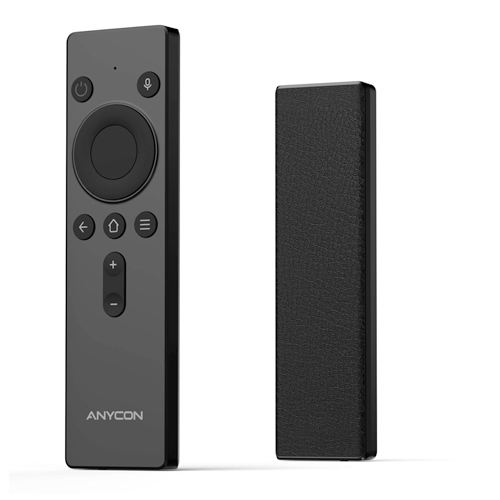
In terms of technical advantages, the smart UWB remote control integrates UWB positioning information with IMU attitude data to achieve centimeter-level spatial positioning and lower-latency response. Compared with traditional infrared and Bluetooth remote controls, UWB offers stronger anti-interference capability. Even in living rooms, meeting rooms, multi-screen environments, and scenarios where multiple devices coexist, it can maintain stable recognition and precise control. Users only need to point the remote control at a screen, device, or designated area to complete operations such as selection, switching, wake-up, and adjustment, transforming the TV from a single display terminal into a smart home interaction center.
From the perspective of industry competition, the current UWB pointing interaction market is mainly driven by three types of players: terminal brands that enhance large-screen ecosystem experiences through self-developed remote controls; remote control OEM/ODM manufacturers that provide customized products for TV, commercial display, and smart home customers; and UWB chip and algorithm solution providers that offer underlying positioning, ranging, and low-power capabilities. Compared with single-solution providers, ANYCON’s advantage lies in its closer understanding of complete-device customer needs. With integrated capabilities in structural design, electronic R&D, mold manufacturing, production delivery, and quality control, ANYCON can help customers move faster from concept verification to mass production.
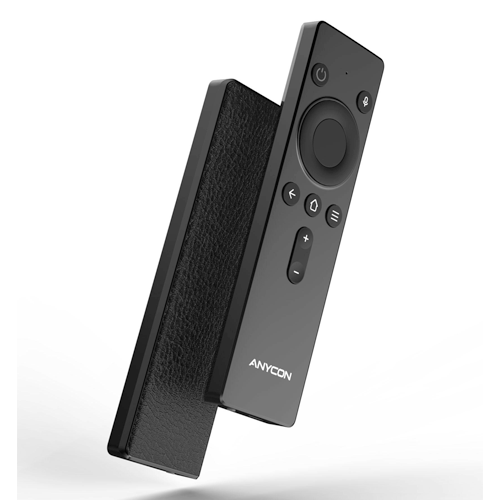
In the future, the UWB omnidirectional remote control will be more than just a TV accessory. It will become a control entry point for intelligent spaces. In smart TV applications, it can be used for program selection, app switching, game control, and smart home linkage. In office meetings, it can enable large-screen page turning, annotation, and multi-screen collaboration. In smart homes, it can support pointing-based control of lighting, air conditioners, curtains, speakers, and other devices. As demand for spatial interaction grows, the TV UWB remote control will continue to move from high-end configurations toward large-scale adoption.
ANYCON will continue to uphold its corporate spirit of pragmatism, innovation, collaboration, and win-win cooperation. By continuously investing in the R&D, manufacturing, and delivery capabilities of smart UWB remote controls, ANYCON will promote the implementation of UWB spatial pointing interaction solutions across more smart terminal scenarios, helping customers create a new generation of remote control experiences that are more precise, more natural, and more competitive.